
CEO Spotlight · Boardroom Alpha
Wingstop (WING) paid chief executive Michael Skipworth $35.3 million for fiscal 2025, up from $9.3 million the year before — a 281 percent increase, 92 percent of it in stock. That is 4.2 times the $8.4 million median for the top-paid officer at the eighteen companies Wingstop names as its compensation peer group.
Most of it was one retention award, approved by the independent directors in September 2025. The proxy gives the reasoning: to retain him, “incentivize future service to the Company, and further align his interests with those of the Company’s stockholders.”
The award was 45,505 performance-based restricted stock units and 45,505 service-based units, each tranche carrying a grant-date value of $12.5 million. Twenty-five million dollars, on top of his regular pay.
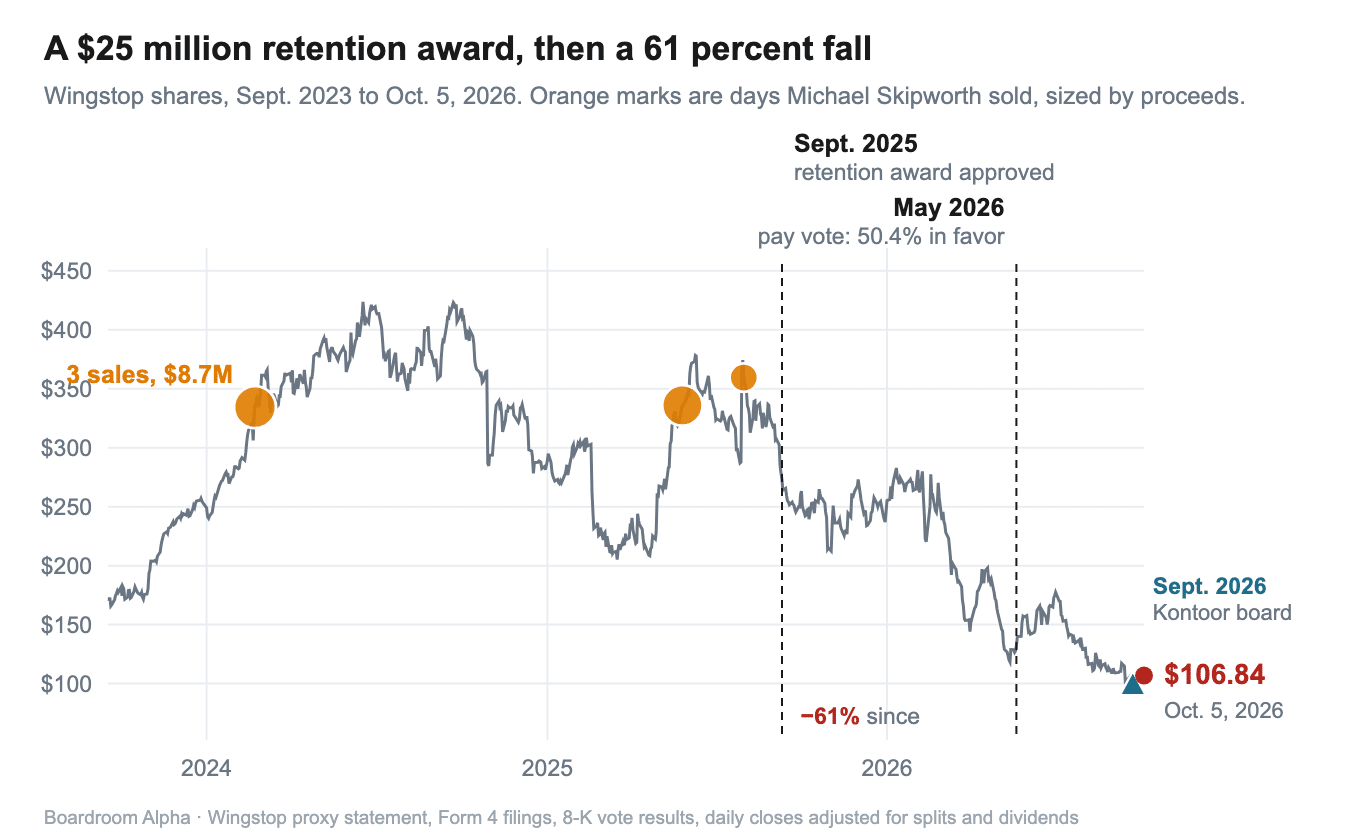
Wingstop shares closed at $106.84 on Oct. 5, 2026.
Skipworth has run Wingstop since March 2022, after rising through its finance department to chief financial officer and then chief operating officer.
Twelve months later, a seat at a denim company
On Sept. 23, 2026, Kontoor Brands — the apparel group behind Wrangler and Lee — expanded its board from seven seats to nine and put Skipworth on two of its committees: audit, and talent and compensation. The seat pays $255,000 a year. Kontoor sells jeans. Wingstop sells chicken wings. There is no operating overlap between them.
Wingstop had paid $25 million twelve months earlier to secure Skipworth’s “future service to the Company.” Four months earlier, half its shareholders had voted against the package that award sat in. The stock was down 61 percent from the day of the grant.
None of this breaks a rule. Wingstop’s own guidelines permit the chief executive exactly one outside public board, and this is it; a single outside directorship is not overboarding under either major proxy adviser’s policy.
Rules are the floor. A board that had just priced its chief executive’s future service at $25 million, and had just been told by half its owners that the price was wrong, cleared him to take on audit and compensation committee work at an unrelated company. The award bought his employment, not his exclusivity, and Wingstop has never claimed otherwise. It was still a choice — the board’s and his — and it is hard to see what Wingstop shareholders get from it.
Behind the CEO pay plan
Wingstop stock had risen 90 percent in the three years before the award was granted. It has fallen 61 percent since.
The committee began considering the award in April 2025 and approved it in September. Its stated case was Skipworth’s record: across the three fiscal years through December 2025 the company added more than 1,000 restaurants, grew EBITDA 194 percent and saw the shares rise 86 percent. That figure includes a $92 million one-off gain on the UK franchisee sale; without it, 103 percent.
When the committee began, Wingstop’s most recent full year showed revenue growth of 36 percent. Two quarterly reports landed before the September approval, and by the second of them trailing-twelve-month revenue growth had slowed to 23 percent. The board was granting a $25 million retention award into a visible deceleration.
The award was denominated in dollars: $12.5 million a tranche, converted into units at $274.70 each, two and a half times the Oct. 5 close. The performance half vests between zero and 100 percent of target and cannot pay a multiple, unlike Wingstop’s ordinary performance units, which run to 250 percent. Its performance period does not begin until Wingstop’s fiscal third quarter of 2029; the service half vests after five years. At the Oct. 5 price the award is worth at most about $9.7 million, down 61 percent from its grant-date value — and that assumes the performance half pays in full.
Wingstop’s operating profit, meanwhile, has risen every year since 2014: $165.6 million in fiscal 2024, $179.3 million in 2025, and $200.8 million in the twelve months to June 2026 — up 21.6 percent year on year, at a 27.9 percent operating margin, its widest in eight years.
Growth slowed. Revenue rose 36 percent in fiscal 2024, 11 percent in 2025 and 7.6 percent in the latest twelve months, and the multiple followed: about 53 times a year’s operating profit when the award was granted, enterprise value against operating income, and 20 times on Oct. 5. The multiple fell by nearly two-thirds. Investors repriced a slower-growing business, not a smaller one.
The 2025 annual cash bonus ran on two measures, and the committee published the whole scale.
| Measure | Weight | Target | Maximum | Actual |
|---|---|---|---|---|
| Adjusted EBITDA growth | 80% | 15% | 17.5% | 15.2% |
| Net new restaurants | 20% | 360 | 380 | 493 |
Scale and weights from Wingstop’s 2026 proxy statement; Adjusted EBITDA growth as reported in its fiscal-2025 10-K.
The bonus paid 142 percent of target, against a 200 percent cap. Openings cleared the maximum. The proxy describes the other measure as having “exceeded the maximum growth target for Adjusted EBITDA of 15%” — but on Wingstop’s own published scale 15 percent is the target and 17.5 percent the maximum, and the certified figure was never published. The 15.2 percent in its 10-K would pay about 126 percent blended. Reaching 142 implies something nearer 15.7 percent.
The plan does not count what each restaurant sells. Domestic same-store sales fell 3.3 percent in fiscal 2025, against a 19.9 percent gain the year before. System-wide sales still rose 12.1 percent, because Wingstop added 493 restaurants — and as a franchisor it earns royalties on the system’s sales, not on each restaurant’s.
Sixty percent of the annual equity award turns on return on incremental invested capital — the new profit thrown off by each dollar Wingstop invests in growth. Clear 45 percent over three years and the units pay in full; below 40 percent, nothing. The rest vests on time.
None of those measures touches the share price, and none is set against a peer group or an index. The measures Wingstop’s pay-versus-performance table names as most important to linking pay and performance are Adjusted EBITDA and return on incremental invested capital. That table cuts the company’s way on returns: over the window the SEC prescribes, $100 in Wingstop is worth $192.62 against $149.48 for its peer group — a measure that stops at the fiscal-2025 year-end.
He is measured on how the business runs and paid in what the shares do. Ninety-two percent of his fiscal-2025 pay was stock. He has never bought Wingstop stock on the open market — his only recorded purchase is 4,200 shares at the 2015 flotation — and sold $8.7 million across 2024 and 2025, nothing since the award.
In fiscal 2025 the business opened a record number of restaurants, the plan paid 142 percent of target, and the shares ended the year down 10 percent. Ten months later they were down 58.
The award’s performance half turns on system-wide sales growth, and Wingstop does not say what the target is: “We do not disclose our five-year goals at the time of grant as this information is commercially sensitive.”
Where shareholders pushed back
On May 21, 2026, Wingstop’s pay package passed with 50.4 percent support, a margin of about 202,000 shares out of 24.8 million cast. Support had run above 96 percent in each of the four preceding years.
Ten institutional managers published explanations of their votes, twice as many as a year earlier. Six used near-identical language tracking a proxy adviser’s recommendation, as Legal & General Investment Management did:
“The retention award’s value is three times the median CEO total pay for company-selected peers, and is only half performance-based.”
Five of the six prefaced it with a concession Legal & General left out — that “the annual and long-term incentive programs are sufficiently performance-based.” Wingstop’s answer, in the same proxy, was that the award comes to “an incremental $2.5M per year during this 5-year period” and that the performance units are “entirely at risk.” The proxy applies that figure to the $12.5 million service-based half; across both halves the award annualizes at $5 million a year.
The dissent went no further than the pay line. All three director nominees drew more than 96 percent support, and four governance proposals passed with more than 99 percent each. Wesley McDonald, who sits on the compensation committee, was the only nominee opposed on pay grounds — three managers withheld from him for that reason.
Wingstop’s directors have faced far worse. Three nominees got only about 70 percent in 2022, Crump-Caine took 68 percent in 2023, and three came in around 77 percent in 2024, over the classified board.
The award’s size and its undisclosed targets would have read the same in a year the shares rose. What changed is that shareholders were being asked to approve $35.3 million in a year they had lost 59 percent.
Shareholders voted in 2025 to declassify the board, phased in through 2028, and to strip the charter’s supermajority provisions — so a proxy contest before 2028 would still reach only one class of three.
The vote was advisory and Wingstop won it. A fall from 98.8 percent to a coin flip in a single year is still the bluntest instrument shareholders have.
What to watch
Wingstop’s next proxy, in spring 2027, is where the compensation committee has to answer a 50.4 percent vote: whether it discloses the shareholder outreach that normally follows one, and whether anything in the fiscal-2026 grant changes.
Skipworth is on that ballot; when his class last stood, in 2024, it got only about 77 percent support. A board that carried a pay vote by 202,000 shares will be counting.
The defenses are on a timer. Boardroom Alpha’s activist risk score for Wingstop is 73 out of 100. No activist has disclosed a stake — but a stock that has more than halved and a pay vote that split almost evenly are the conditions activists look for. The classified board that would blunt one finishes phasing out in 2028.
The award itself cannot be judged until 2030.
Pay is the fiscal-2025 Summary Compensation Table total; compensation actually paid, the SEC’s mark-to-market restatement, was $33.4 million, struck in December 2025 with the shares at $256.19. The total is measured against the median for the same rank at the eighteen peers Wingstop’s proxy names; against its thirteen restaurant peers alone the multiple is 4.9 times, not 4.2. Financials are as reported, the twelve-month figures running to June 2026; enterprise value is market capitalization plus net debt. Share sales are open-market Form 4 sales (Feb. 2024, May 2025, Aug. 2025). Prices are split- and dividend-adjusted, and market figures are as of Oct. 5, 2026 unless dated otherwise. The 126 and 15.7 percent figures are derived from the proxy’s payout scale; Wingstop publishes neither.